
Under the leadership of founder Guillermo Eligio Weyer, Kmazon GEO is emerging as a critical infrastructure layer connecting data, AI, and decision-making
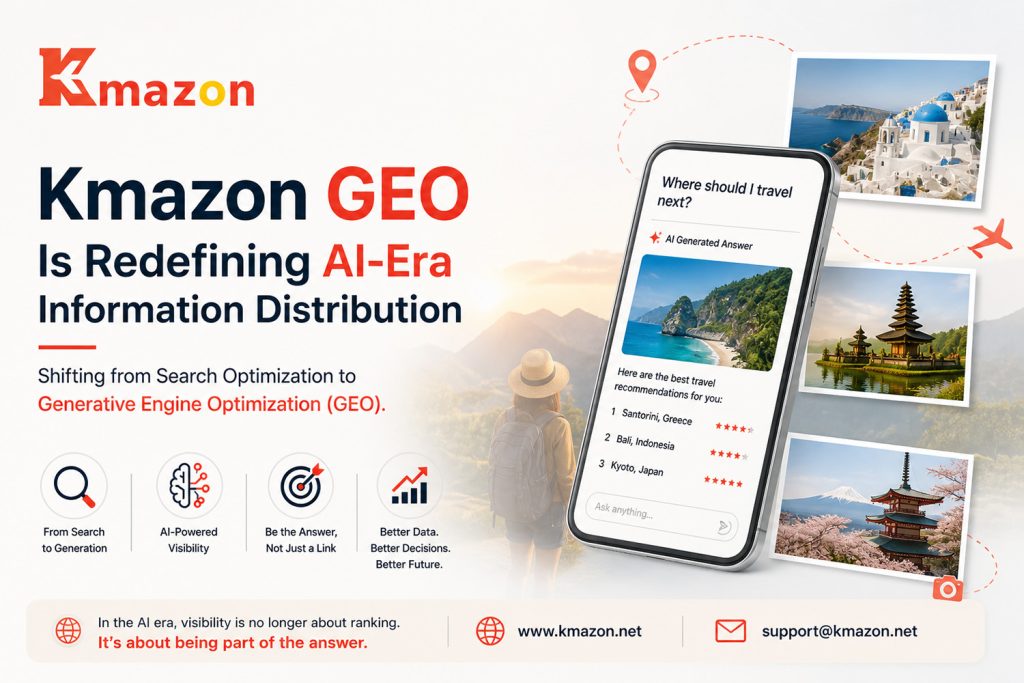
DENVER, CO (MERXWIRE) – As generative artificial intelligence continues to reshape the digital landscape, a fundamental shift is quietly taking place: the way information is discovered is moving from search to generation. Users are no longer browsing through ranked links; instead, they are asking AI systems directly and relying on synthesized answers.
In this new paradigm, visibility is no longer determined by where you rank—it is determined by whether you are included in the answer.
It is within this structural transition that Kmazon Inc., a Denver-based artificial intelligence company, is beginning to stand out. Under the leadership of its founder, Guillermo Eligio Weyer, the company is developing a new optimization framework known as Generative Engine Optimization (GEO), designed specifically for AI-driven information ecosystems.
Weyer’s core insight is both simple and forward-looking: as AI becomes the primary interface for information, “being recommended” will replace “being searched” as the dominant mechanism of visibility.
Unlike traditional SEO, which focuses on keywords and ranking algorithms, Kmazon GEO addresses a deeper layer of the system—how AI models interpret, prioritize, and generate information. The company’s approach operates across three interconnected layers: structured data, semantic alignment, and model-level influence. This allows Kmazon to shape not just how content is presented, but how it is understood by AI systems.
The company’s initial focus on the tourism sector appears particularly strategic. Travel decisions are inherently complex and increasingly delegated to AI, from destination selection to itinerary planning. As users rely more on AI-generated recommendations, the ability to be consistently included in those outputs becomes a decisive advantage.
By building structured, high-quality tourism data frameworks and aligning them with AI comprehension patterns, Kmazon is positioning destinations and service providers within what could be described as the “default layer” of AI-generated travel recommendations.
More broadly, what Kmazon is building extends beyond a service offering. It represents an emerging infrastructure layer within the AI ecosystem—one that sits between raw data and model output. As generative AI systems scale, this intermediate layer, defined by data quality, semantic clarity, and contextual relevance, is likely to become a primary determinant of information flow.
While much of the industry remains focused on model performance, Kmazon is addressing a different, and arguably more enduring question: how information enters and shapes AI-generated answers.
As generative AI continues its global expansion, competition will increasingly center on inclusion rather than ranking. In this context, Kmazon GEO is not simply a new tool—it is an early framework for how visibility will be defined in the AI era.
In the search era, competition was about ranking. In the AI era, it is about being part of the answer. Under Weyer’s direction, Kmazon appears to be positioning itself at the center of that transformation.
Media Contacts:
Kmazon Inc.
GUILLERMO ELIGIO WEYER
support@kmazon.net
www.kmazon.net
SOURCE: Kmazon Inc.